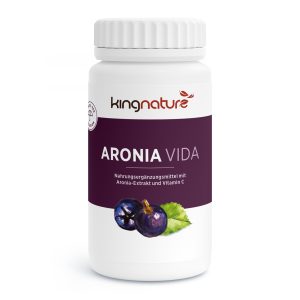
Popular Products

Aronia Vida
CHF 69.00
Micronutrients are trace elements (minerals) and vitamins. They are required by the human body in smaller quantities than macronutrients. Micronutrients are essential for the smooth functioning of numerous processes in the body. Most micronutrients cannot be produced by the body itself. They must therefore be obtained from the daily diet.

Minerals and trace elements are needed by the body to produce messenger substances, transmit nerve impulses, carry out enzyme reactions, divide cells, maintain a functioning metabolism and keep the nervous system intact. Some micronutrients have an antioxidant effect and protect the body from free radicals. Vitamins, on the other hand, are involved in numerous processes in the body. A distinction is made between water-soluble and fat-soluble vitamins. Fat-soluble vitamins are vitamins A, K, D, and E. The group of water-soluble vitamins includes vitamin C and the B vitamins B1, B2, B3, B5, B6, B7, B9, and B12. They are stored in large quantities, mainly in the liver.
The various vitamins perform the following functions:
Minerals are also essential for water balance and metabolism. This group includes sulfur, phosphorus, chlorine, magnesium, calcium, potassium, and sodium. They are found in cell fluid and blood.
Trace elements are required by numerous enzymes. This group includes cobalt, chromium, molybdenum, fluorine, selenium, manganese, copper, zinc, iodine, and iron. Selenium supports the detoxification of the body. Phosphorus and calcium perform important functions in the body in the formation of hard tissue in the teeth and bones. Silicon supports the function of connective tissue, iron supports muscle function. Iron is involved in oxygen transport in the body and iodine is an important component of hormones.


Make sure that the place of delivery and the language correspond to your region. Otherwise, change your selection:
 Switzerland
Switzerland
Switzerland Europe
 Weitere Länder
 English
English
English Deutsch
 Français
 Italiano